About Gas Furnaces
The following covers information about gas furnaces that are typically installed in the basement of the home. A natural gas furnace remains the most popular way to heat home’s in Ontario, Canada, due to its lower installation cost with several brands manufacturing a wide range of furnaces.
A furnace comes in three levels of technology: Single Stage, Two-Stage, and Modulating. But, it will be easier to understand the types if you first understand the working parts inside of your furnace.
The Basics of Gas Furnaces
Before we can understand the different types of furnaces, we must first understand the basics of your home’s Heating, Ventilation, and Air Conditioning system (HAVC).
The furnace needs your home to be equipped with:
- Gas piping hook up to natural or propane gas
- A gas meter to measure usage
- Duct work & vents to carry air
- Thermostat & Electrical panel wiring
- CO2 detector
All of these components must be inspected and installed by a license gas technician.
How A Furnace Heats Your Home
A gas furnace uses combustion to produce heat and then blow air via a motor across a transfer plate called a Heat Exchanger. The harmful substances form the combustion process are housed inside a sealed container within the furnace and then vented safely outside of the home. The result is heated air is blown directly into the rooms of your home though the duct work.
Air Flow Gives You Control
The duct work is a set of large metal boxes that run through the walls, floors and ceilings of your home ending in an air vent or register. The duct work sits on top of the furnace (or on its side) and creates a looping air system throughout your home.
The blower motor component of the furnace then circulates the air through these metal boxes. This motor also pulls unheated air from the outside of the home, so fresh air enters the home.
The Furnace Cycle Keeps Your Home Warm
Your furnace is not constantly blowing hot air into your home but rather cycling on and off on a set schedule. This method allows your home to stay warm, run your furnace less often, and hold your home at a set temperature.
Imagine if you left your home and turned off your furnace for several hours on a very cold day. Once you got home, it would be rather cold inside your home and would take a long time become warm once again. The home would have lots of cold air trapped inside of it and it will take time to re-circulating the air replacing cold with warm.
Instead, a furnace cycle is a set period time the furnace turns on and off, maintaining the heat in the home throughout the day. This cycle is controlled by the thermostat which tells the furnace how to operate keeping your home warm in the winter. This is why it is recommended to set your thermostat and forget it.

Typical HVAC Set Up
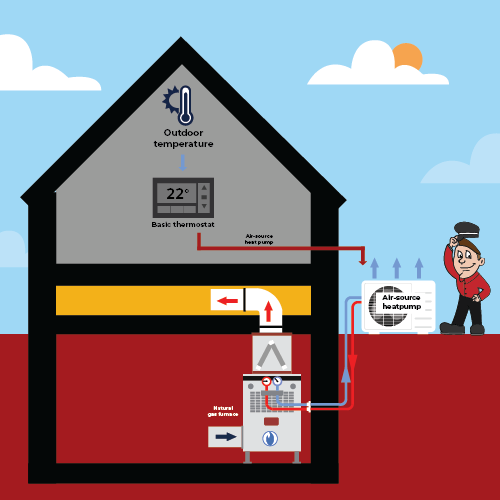
The furnace is located in the basement. The cooling unit is made up of a coil that sits on the furnace and the outdoor unit. The air moves through the sheet metal duct work. Everything is controlled by the home’s thermostat.
Gas Furnace Diagram
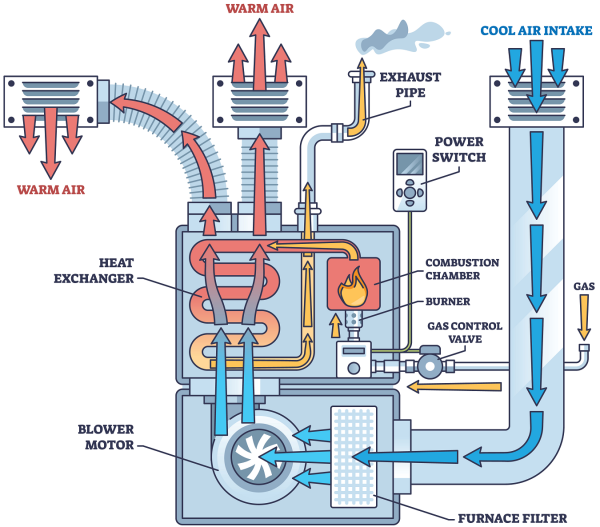
All furnaces have the same set of components regardless of brand or the type of the furnace. A better furnace, a more efficient model, will have parts that are betting at controlling the fan speed, the fuel used, and way air is brought into the unit. Find more about furnace brands on another tips page. Different parts of the furnace:
Burner: Ignites gas to create heat.
Draft Inducer: Pulls air into the burner and pushes exhaust outside.
Heat Exchanger: Transfers heat from the flame to the air.
Igniter/Pilot Light: located in the burner & starts the burner flame.
Thermostat: Controls when the furnace turns on or off.
Blower Fan: Circulates warm air through the home.
Exhaust: Releases exhaust gases safely outdoors.
Furnace Filter: Cleans air before it enters the furnace.
Combustion Chamber: Where the gas burns to produce heat.
Warm Air Vent: Delivers heated air into the rooms.
Cold Air Vent: Brings cool air back to the furnace.
Power Switch: Safety switch for the furnace’s electrical system: on or off.
Gas Control Valve: Regulates gas flow to the burners.
- Gas: the propane or natural gas hook up
Single Stage Gas Furnace
A single stage gas furnace only has one full power burning setting. This leads to lower efficiency and a lack of control over how the furnace heats the home. This sign-wave shows how a single stage furnace burns its fuel and swings between high and low.
Off or On
Two-Stage Gas Furnace
A two-stage furnace has two stages of heat: High & low. This allows the furnace to cycle between a low and high setting to reach a good level of comfort inside of the home while using less fuel. This sign-wave shows how a two-stage furnace shifts between temperature to smooth out the temperature swing.
High or Low
Modulating Gas Furnace
Sometimes also called variable-capacity, a modulating furnace uses only as much gas is needed to achieve the desired temperature by controlling how wide the gas valve can open from 0 to 100 degrees. The sign-wave is precise and rather picks its temperature with next to no swing.
A modulating furnace gives you more control and therefore more energy savings, but at a higher installation and equipment cost.
Incremental Control